

Holiday cookies around the world reflect local ingredients, religious festivals, family customs and changing gift traditions. German Lebkuchen, Danish vanilla rings, Middle Eastern ma’amoul and decorated North American sugar cookies all belong to different histories. Contemporary festive boxes may also include matcha cookies, chocolate biscuits or New Zealand butter cookie tins.
There is no single global holiday cookie. The most accurate way to compare them is by occasion, flavour, texture and how they are shared. Traditions also vary between regions, communities and individual households.
Global Holiday Cookies at a Glance
Some festive biscuits are closely tied to a particular celebration. Others are everyday or regional styles that become part of a seasonal assortment. The table below distinguishes those roles instead of treating every example as a national tradition.
| Region | Examples | Festive context | Typical character |
|---|---|---|---|
| German-speaking Europe | Lebkuchen and other spice cookies | Advent and Christmas | Honey, nuts and warm spices, depending on the recipe |
| Denmark and Northern Europe | Vaniljekranse and butter cookies | Christmas baking and seasonal gift tins | Buttery, vanilla-led and usually crisp |
| France and Italy | Sablés, biscotti and regional biscuits | Festive assortments and family tables | Butter, almonds, citrus, honey or spice |
| East Asia | Matcha cookies and boxed biscuits | Contemporary seasonal gifting and family sharing | Tea, sesame, fruit or familiar bakery flavours |
| South Asia and the Middle East | Nankhatai and ma’amoul | Diwali, Eid or Easter in relevant communities | Ghee, cardamom, semolina, dates or nuts |
| The Americas | Sugar cookies, gingerbread, polvorones and alfajores | Christmas and other festive gatherings | Decorated, spiced, crumbly or filled |
| New Zealand | Shortbread-style biscuits and butter cookie tins | Summer Christmas tables and food gifting | Butter-led baking alongside fruit and summer desserts |
European Holiday Cookie Traditions
Lebkuchen and German Christmas baking
Lebkuchen is strongly associated with German Advent and Christmas markets. Recipes differ, but many versions combine honey or another sweetener with nuts and spices such as cinnamon, cloves or anise. Some are soft and cake-like; others are firmer, glazed or coated in chocolate. Nuremberg is particularly well known for its Lebkuchen tradition.
Lebkuchen is only one part of German festive baking. Households may also prepare cut-out biscuits, vanilla crescents or jam-filled cookies. That variety is important: even within one country, there is no single recipe that represents every family.
Danish vanilla rings and butter cookie tins
Danish vaniljekranse are piped vanilla butter cookies shaped into rings. They are associated with Christmas baking, while Danish butter cookie assortments have also helped establish the decorated metal tin as a familiar international gift format. Their crisp texture is different from softer gingerbread and from the very delicate crumb of some other butter-rich cookies.
French and Italian regional biscuits
French sablés are fine, sandy-textured butter biscuits that may be included in festive assortments, although they are not exclusive to one holiday. Italy has even greater regional variation. Biscotti or cantucci may be served with coffee or a dessert drink, while Christmas tables can also include regional biscuits made with almonds, citrus, honey, dried fruit or spice. It is more accurate to describe these as a family of local traditions than as one national Italian Christmas cookie.
East Asian Festive Cookies and Tea Flavours
East Asia contains many distinct food cultures, so it should not be reduced to a single preference for restrained sweetness or tea flavours. In Japan, Western-style cookies are widely used in contemporary confectionery and souvenir gifting. Matcha is one flavour found in modern sweets and seasonal gift boxes, but a matcha butter cookie should not be presented as an ancient Japanese holiday tradition.
During Lunar New Year, families in China and other communities may offer or exchange packaged biscuits, pastries and confectionery. The selection varies by region and household. Presentation and shareability can matter, but they do not make one type of cookie universally suitable. For a focused discussion, see the Lowrey guide to Spring Festival cookies and food gifting.
South Asian and Middle Eastern Festive Biscuits
Nankhatai is a short, crumbly South Asian biscuit commonly made with flour, ghee or butter and ingredients such as cardamom. It may appear in festive assortments, including Diwali sharing, but recipes and customs differ across India and neighbouring countries.
Ma’amoul has a more direct connection to religious celebrations in many Middle Eastern communities. The moulded pastry is commonly made with semolina or flour and filled with dates, pistachios or walnuts. It is associated with Eid and with Easter among some Christian communities. Shape, filling and decoration can identify different versions. Because nuts, wheat, dairy, egg or sesame may be present in festive biscuits, the recipe or product label should always be checked.
Holiday Cookies in the Americas
In the United States and Canada, festive baking often includes decorated sugar cookies, gingerbread people, shortbread and family recipes passed between generations. Cookie exchanges and mixed platters allow several households to contribute different styles. The shared activity—baking, decorating and giving—can be as important as the flavour.
Across Latin America, festive sweets differ widely by country and region. Crumbly polvorones, sandwich-style alfajores and local spiced or filled biscuits may appear at celebrations, but none should be treated as universal across the continent. The broad pattern is diversity: wheat, corn, coconut, nuts, dulce de leche, fruit and regional spices can all shape local baking.
New Zealand Summer Christmas and Butter Cookie Tins
Christmas arrives during the New Zealand summer. Outdoor meals, seafood, barbecues, seasonal fruit and pavlova can all be part of the wider holiday table. Cookies and biscuits complement these foods as small portions for afternoon tea, host gifts or shared dessert platters; New Zealand does not have one mandatory national Christmas cookie.
Lowrey Original Butter Cookies provide one current New Zealand example. They are handcrafted in New Zealand with four simple ingredients and contain 42% New Zealand grass-fed cultured butter. The cookies are delicate, very fragile and melt-in-the-mouth—not hard or strongly crunchy. Their texture comes from the complete recipe and production process, not from the butter percentage alone.
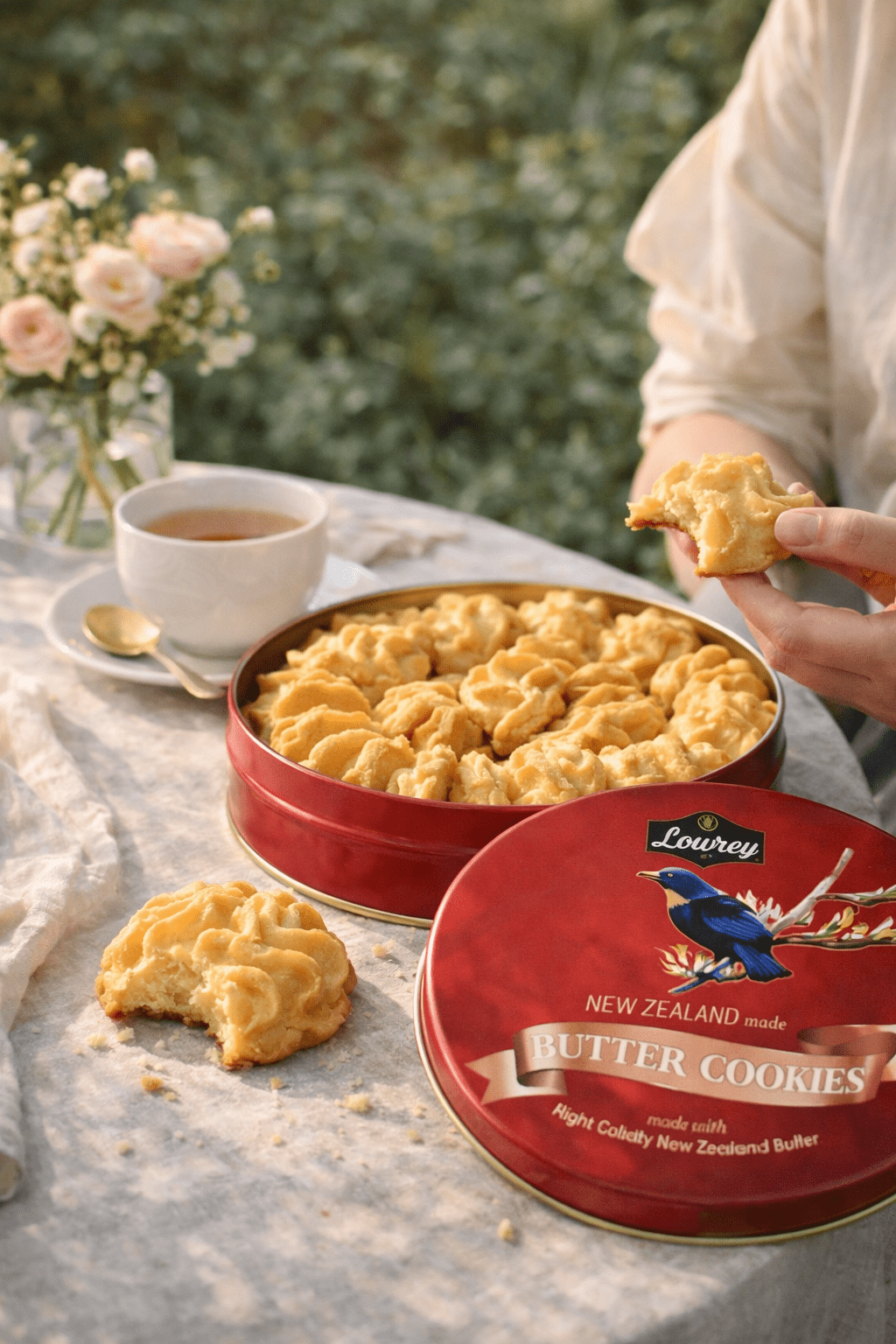
The red metal tin gives the product a complete gift presentation, but it cannot guarantee that every delicate cookie will remain unbroken. Lowrey also makes Coffee, Chocolate, Matcha, Raspberry and Black Sesame butter cookies, each with its own recipe and butter percentage. Every tin contains one flavour; fixed multi-flavour gift packs contain several separate tins. Explore the current Lowrey Butter Cookies collection for available flavours and pack formats.
How to Build a Global Holiday Cookie Platter
A global platter works best as a respectful selection of clearly identified cookies, not as a claim that a few recipes represent whole cultures. Choose three or four contrasting styles, such as a soft spice cookie, a crisp biscuit, a filled pastry and a delicate butter cookie.
- Label each style: Give the cookie name, place or community connected with it and the relevant celebration.
- Balance textures and flavours: Combine spiced, buttery, tea-based, fruit-filled or nut-filled options without making every item similar.
- Separate allergens: Identify wheat, milk, egg, nuts, sesame and other allergens, and use separate utensils where needed.
- Serve delicate cookies carefully: Keep fragile styles in a single layer or in their own tin until serving.
Choose around the preferences and dietary needs of the people who will eat the cookies. For a separate buying comparison, read how to compare holiday cookie gifts. For a New Zealand element, add a clearly labelled Lowrey tin without presenting it as a substitute for another culture’s traditional recipe.
Frequently Asked Questions
What are holiday cookies around the world?
Holiday cookies around the world are biscuits, cookies and small pastries prepared, served or given during festivals and seasonal celebrations. Examples include German Lebkuchen, Danish vaniljekranse, Middle Eastern ma’amoul, decorated North American sugar cookies and many regional family recipes.
Which countries have traditional holiday cookies?
Many countries and communities have festive cookie traditions. Germany is known for Lebkuchen, Denmark for vaniljekranse, and many Middle Eastern communities for ma’amoul at Eid or Easter. Italy, France, India and countries across the Americas also have regional festive biscuits, but traditions vary within every country.
Are matcha cookies traditional Japanese holiday cookies?
Not in the same sense as a long-established festival recipe. Matcha is used in Japanese sweets, and matcha cookies can appear in modern seasonal confectionery and gift boxes, but they should be described as a contemporary tea-flavoured cookie rather than a universal Japanese holiday tradition.
What cookies are associated with Eid?
Ma’amoul is associated with Eid in many Middle Eastern communities. It is a moulded pastry commonly filled with dates, pistachios or walnuts. Recipes, shapes and fillings vary, and ma’amoul is also connected with Easter in some Christian communities.
What cookies suit a New Zealand summer Christmas table?
There is no single required New Zealand Christmas cookie. Butter cookies, shortbread-style biscuits, fruit-flavoured cookies and other small baked treats can complement seasonal fruit, pavlova and summer gatherings. The choice should reflect the guests’ preferences and dietary needs.
Are Lowrey Butter Cookies made in New Zealand?
Yes. Lowrey Butter Cookies are handcrafted in New Zealand with New Zealand grass-fed cultured butter and presented in red metal gift tins. Original contains 42% New Zealand grass-fed cultured butter and uses butter, wheat flour, corn starch and icing sugar.

