

A beautiful tin can catch your eye. The useful information is usually written somewhere smaller.
Not every product labelled “butter cookies” uses the same amount of butter, the same type of fat, the same flavour ingredients or the same production method. Two tins may look similar while offering very different flavours, textures, weights and levels of product transparency.
The most reliable way to identify quality butter cookies is to examine details that can be checked rather than relying only on words such as premium, traditional, luxury or gourmet.
Check the main fat source, disclosed butter percentage, complete ingredient list, intended texture, real flavour ingredients, colour, net weight, manufacturing origin, allergen information, shelf life and storage instructions. Quality does not require every butter cookie to taste the same. It requires the product to clearly explain what it is and deliver the flavour and texture it promises.
Looking to buy premium butter cookies? Explore the Lowrey Butter Cookies collection for current flavours, gift tins and product options. This guide focuses on how to evaluate butter cookie quality rather than recommending one product as universally best.
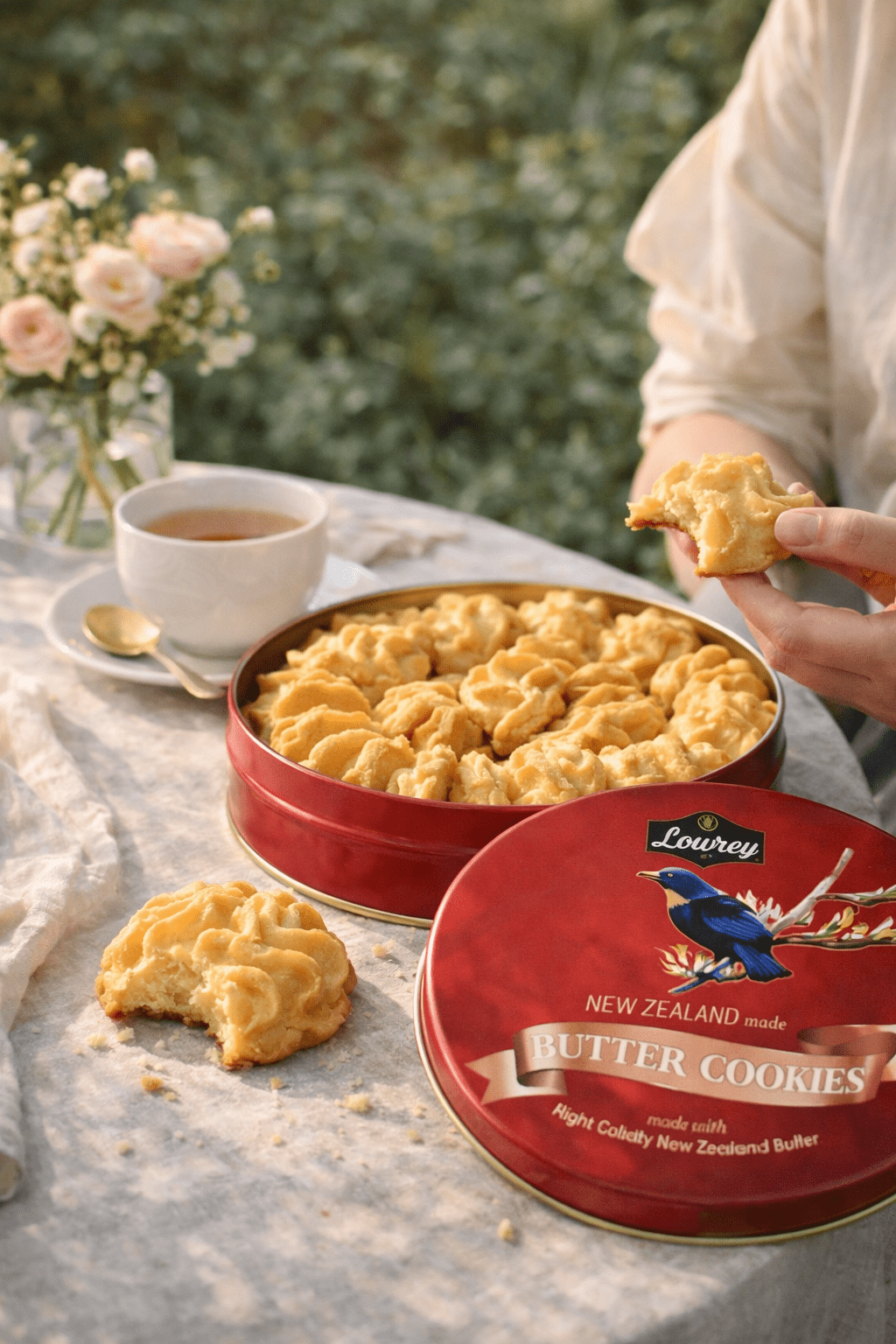
What does quality mean in a butter cookie?
Quality does not mean every butter cookie should be identical. Some are designed to be crisp and firm. Others are short, crumbly, delicate or quick to melt in the mouth.
One texture is not automatically superior to another. A well-made crunchy biscuit should provide a clean snap and the flavour it promises. A delicate butter cookie should break down gently rather than feeling hard, dry or unexpectedly tough.
Useful questions include:
- Does the ingredient list support the name and product description?
- Is the primary fat source clearly stated?
- Is the butter percentage disclosed accurately?
- Are the flavour ingredients identified?
- Does the actual texture match the style described?
- Are origin, allergens, net weight and storage details easy to find?
Butter source
Check whether the product uses butter, vegetable fat or a combination of fats.
Butter percentage
A disclosed percentage helps you understand how central butter is to the recipe.
Ingredient list
Look for specific ingredients, flavour sources and responsible allergen information.
Intended texture
Decide whether you want crisp, crunchy, short, crumbly or melt-in-the-mouth.
Flavour source
Check what actually creates the coffee, cocoa, tea, fruit or sesame flavour.
Colour
Judge colour according to the named flavour rather than one universal standard.
Net weight
Compare the declared food weight rather than relying only on the apparent size of the tin.
Manufacturing origin
Distinguish where the brand began from where the cookies are actually made.
Product information
Review allergens, best-before guidance, shelf life and storage instructions.
Check the main fat source
Butter cookies can be made with different fat systems. The ingredient list may identify:
- Butter
- Vegetable oil
- Palm oil
- Margarine
- Shortening
- A mixture of butter and vegetable fats
These ingredients behave differently. They affect aroma, flavour release, firmness, melting behaviour, mouthfeel and production cost.
A vegetable-fat cookie is not automatically poorly made. It is, however, a different product from one in which butter is the main fat. If you are specifically looking for butter-forward flavour, the label should identify butter clearly rather than relying on a phrase such as “butter flavoured”.
Lowrey example: Lowrey Butter Cookies use New Zealand grass-fed cultured butter. “Grass-fed” describes the pasture-based dairy origin, while “cultured” describes how the cream is developed before churning.
Look for a disclosed butter percentage
A clearly disclosed butter percentage gives customers a useful way to understand how much of the recipe is actually butter.
A higher percentage does not automatically guarantee a better cookie. The result also depends on:
- The type and amount of flour
- The balance between flour and starch
- The amount and type of sugar
- Moisture
- Mixing and shaping
- Cookie thickness
- Baking and cooling
- The intended final texture
Disclosure still matters because it allows a meaningful comparison. It is more useful than relying only on broad descriptions such as rich or buttery.
Lowrey example: Lowrey Original Butter Cookies are made with 42% New Zealand grass-fed cultured butter. The 42% figure applies to Original. Other Lowrey flavours use their own butter percentages and flavour-specific recipes.
Read the complete ingredient list
A short ingredient list is not automatically better, but it is often easier to understand. More important than length is whether the list clearly identifies what the product contains.
Check:
- Which fat or fats are used
- Whether wheat flour or another flour is used
- Whether starch is included
- Which form of sugar is used
- Whether eggs are included
- Which ingredients create the named flavour
- Which allergens are present
- Whether preservatives or flavourings are listed
Avoid treating phrases such as “zero additives” or “completely additive-free” as universal guarantees. An ingredient such as cocoa, matcha or freeze-dried fruit is still an added ingredient, even though it may be a genuine and desirable part of the recipe.
Lowrey Original: Original uses four simple ingredients: New Zealand grass-fed cultured butter, wheat flour, corn starch and icing sugar.
Other Lowrey flavours: Coffee, Chocolate, Matcha, Raspberry and Black Sesame include their own flavour ingredients and therefore do not have the same four-ingredient formula as Original.
Preservatives: Lowrey Butter Cookies are made without artificial preservatives.
Read more about Lowrey’s ingredient choices on the Premium New Zealand Ingredients page and WHY.002: Why Only Four Ingredients?
Understand the intended texture
Butter cookies can be described as:
- Firm
- Crunchy
- Crisp
- Short
- Crumbly
- Delicate
- Melt-in-the-mouth
These words are not interchangeable. A firm biscuit has a stronger structure and may produce a distinct snap. A short, delicate cookie breaks down more easily and may soften quickly in the mouth.
Fragility is not automatically a defect. A cookie designed with a very fine and short structure may naturally be easier to break during handling than a dense, compact biscuit.
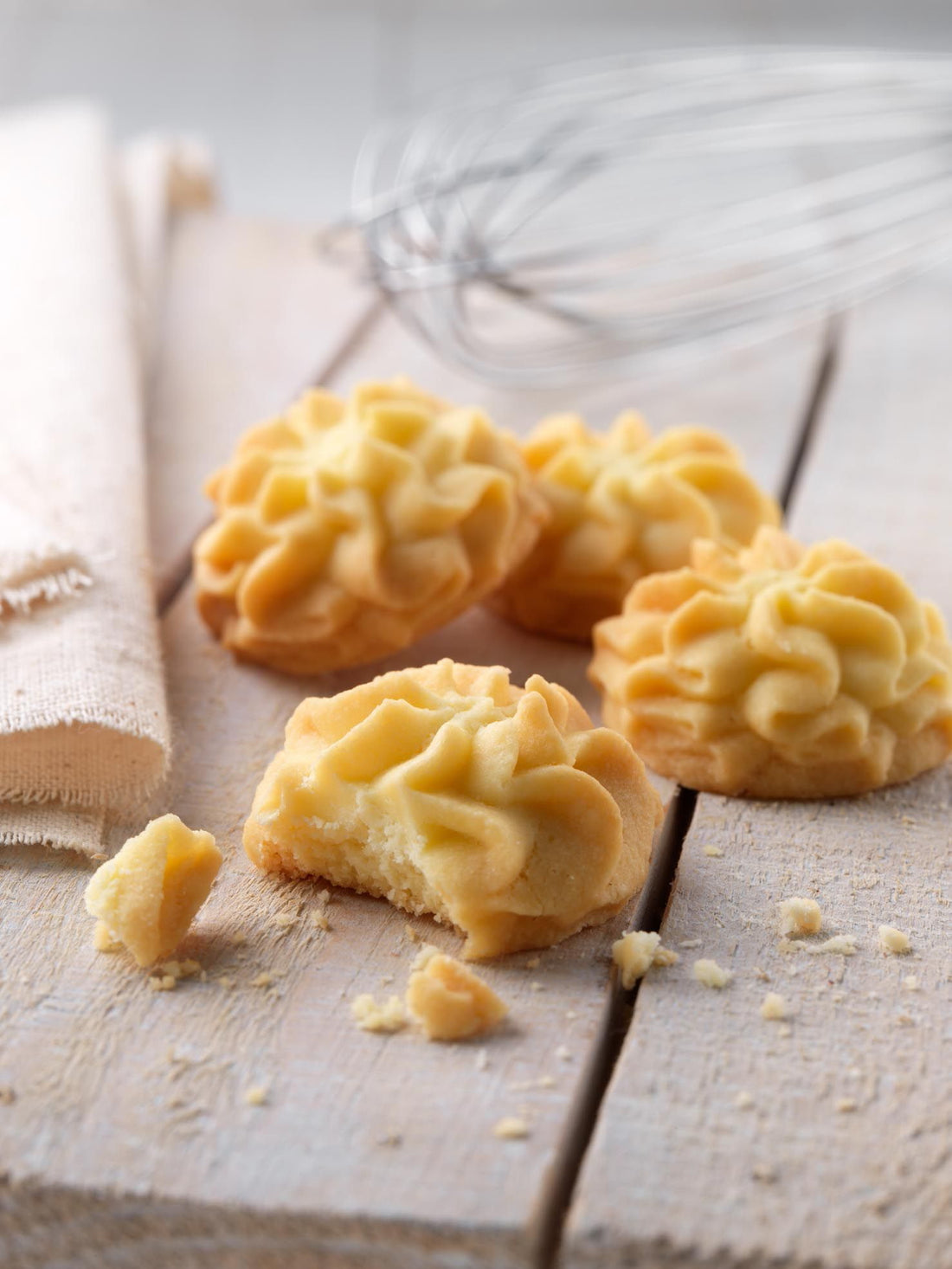
Lowrey texture: Lowrey Butter Cookies are designed to be delicate, very fragile and melt-in-the-mouth rather than hard or crunchy.
Learn how the complete recipe creates this structure in The Science of Butter Cookies.
Check what creates the flavour
For flavoured butter cookies, look beyond the name printed on the front of the package. The ingredient list should help explain where the flavour comes from.
Examples include:
- Coffee
- Cocoa powder
- Matcha or another tea powder
- Freeze-dried fruit
- Sesame seeds
- Spices
- Natural or artificial flavouring
A named ingredient provides more information than a broad phrase such as “premium flavour”. It also helps customers understand why different flavours may require different formulas.
| Lowrey flavour | Primary flavour direction | Why the recipe differs |
|---|---|---|
| Original | New Zealand grass-fed cultured butter | The simplest butter-focused expression, made with four ingredients. |
| Coffee | Coffee aroma and deeper roasted notes | Coffee changes flavour intensity and requires its own butter and sweetness balance. |
| Chocolate | Dutch cocoa | Cocoa affects colour, bitterness, fat absorption and dough structure. |
| Matcha | Shizuoka matcha | Matcha adds tea aroma, colour and gentle bitterness. |
| Raspberry | Freeze-dried raspberry | Fruit powder contributes concentrated fruit flavour, colour and natural acidity. |
| Black Sesame | Toasted black sesame | Sesame changes flavour, oil content, colour and the balance of the crumb. |
Judge colour according to the flavour
There is no single correct colour for every butter cookie.
Original may be pale or lightly golden depending on its ingredients and baking style. Coffee, chocolate, matcha, raspberry and black sesame cookies should naturally look different.
A useful colour check asks whether:
- The colour is appropriate for the named flavour
- The cookies appear reasonably consistent within the batch
- They do not look excessively burnt
- The appearance matches the ingredients described
Colour alone cannot prove butter content, ingredient quality or manufacturing origin. It should be considered together with the ingredient list and product information.
Compare net weight, not only tin size
A larger container does not always hold more food. Tin size can be influenced by:
- Cookie shape and thickness
- Protective spacing
- Internal trays or dividers
- Product density
- The amount of empty space
- The purpose of the packaging
Compare the printed net weight when evaluating quantity and value. Different flavours may also have different net weights because their ingredients and structures are not identical.
Price per gram can be useful, but it is not the only consideration. Butter content, ingredient origin, production, packaging and gifting presentation may all affect the final price.
Check where the cookies are made
Brand origin and manufacturing origin are not always the same.
A brand may have been founded in one country, be owned in another and manufacture its products somewhere else. Look for a clear statement such as:
- Made in New Zealand
- Product of New Zealand
- Manufactured in another named country
- Packed locally using imported ingredients
Do not infer manufacturing origin only from a brand name, flag, landscape image or packaging style.
Lowrey example: Lowrey Butter Cookies are made in New Zealand. This manufacturing statement does not mean every flavour ingredient is grown in New Zealand. Ingredients such as Dutch cocoa and Shizuoka matcha are selected for their own origins and characteristics.
Review allergens, shelf life and storage guidance
Clear product information is part of quality. Before buying, check:
- Milk or dairy allergen information
- Wheat and gluten information
- Egg content
- Sesame, nut and cross-contact statements
- Best-before date
- Unopened storage instructions
- Advice after opening
Lowrey Butter Cookies are made without egg, but a recipe that does not use egg is not automatically guaranteed to be suitable for every person with an egg allergy. Customers with allergies should always review the current product label and allergen information.
Lowrey Butter Cookies have a shelf life of approximately nine months when unopened and stored correctly. After opening, reseal the tin and enjoy the cookies within approximately four weeks.
Does a longer shelf life mean preservatives were added?
Not necessarily.
Shelf life can be influenced by:
- Moisture content
- Water activity
- Fat composition
- Production hygiene
- Oxygen exposure
- Packaging
- Storage temperature
Read the ingredient list rather than assuming that every shelf-stable cookie contains artificial preservatives.
Lowrey product fact: Lowrey Butter Cookies are made without artificial preservatives. Their shelf life also reflects their baked, relatively low-moisture structure and sealed packaging.
Does attractive packaging prove quality?
No. Packaging can protect the product and improve presentation, but it cannot replace clear ingredient and manufacturing information.
A metal tin may provide:
- Greater external protection than a soft bag
- A gift-ready presentation
- A lid that can be closed again
- A reusable container after the cookies are finished
A tin cannot tell you how much butter is in the recipe, which other fats are used, where the cookies are made or whether the product suits your dietary needs. Those answers must come from the label and product information.
Clear information explains it.
How Lowrey compares with the nine checks
Lowrey Butter Cookies are intended for customers who value a butter-forward flavour, delicate texture, New Zealand manufacture and gift-ready presentation.
New Zealand grass-fed cultured butter.
Original contains 42% New Zealand grass-fed cultured butter.
Each flavour uses its own butter percentage and flavour-specific recipe.
New Zealand grass-fed cultured butter, wheat flour, corn starch and icing sugar.
Made without artificial preservatives.
Made without egg. Customers with allergies should still check the current product label and allergen information.
Delicate, very fragile and melt-in-the-mouth rather than hard or crunchy.
Made in New Zealand.
Single-flavour red metal gift tins with tight-fitting lids.
Approximately nine months unopened and approximately four weeks after opening when resealed and stored correctly.
Is Lowrey the right butter cookie for everyone?
No single cookie style suits every customer.
Lowrey may be a good choice for someone who values:
- New Zealand grass-fed cultured butter
- A delicate, melt-in-the-mouth texture
- Clearly separated single-flavour tins
- New Zealand manufacture
- Gift-ready red metal packaging
- Food gifts for family, clients or overseas recipients
It may be less suitable for someone who wants:
- A very hard or strongly crunchy biscuit
- A mixed assortment inside one tin
- A product without dairy or wheat
- The lowest possible price per gram
- A cookie designed to resist all breakage during handling
Quality is not the same as universal preference. The useful question is whether the product’s ingredients, texture, presentation and price match the reason you are buying it.
Compare the details for yourself
Explore six single-flavour Lowrey Butter Cookie gift tins, made in New Zealand with New Zealand grass-fed cultured butter.
Shop Premium Butter CookiesFrequently asked questions
What should I look for in quality butter cookies?
Check the main fat source, disclosed butter percentage, full ingredient list, intended texture, flavour ingredients, net weight, manufacturing origin, allergen information, shelf life and storage guidance.
Does a higher butter percentage always mean a better cookie?
No. Butter percentage is useful information, but the final result also depends on flour, starch, sugar, moisture, mixing, shaping, baking and the intended texture.
Are quality butter cookies supposed to be crunchy?
Not necessarily. Butter cookies may be crisp, crunchy, short, crumbly, delicate or melt-in-the-mouth. A quality product should deliver the texture it promises.
Why are some butter cookies fragile?
A fine, short structure may make a cookie easier to break while also helping it crumble gently and soften quickly in the mouth. Fragility can be part of the intended texture.
Do Lowrey Butter Cookies contain artificial preservatives?
No. Lowrey Butter Cookies are made without artificial preservatives.
Does every Lowrey flavour contain 42% butter?
No. The 42% figure applies to Lowrey Original Butter Cookies. Other flavours use their own butter percentages and flavour-specific recipes.
Do all Lowrey flavours contain only four ingredients?
No. The four-ingredient recipe applies to Original. Coffee, Chocolate, Matcha, Raspberry and Black Sesame contain additional flavour ingredients.
Are Lowrey Butter Cookies made with egg?
Lowrey Butter Cookies are made without egg. Customers with food allergies should still review the current product label and allergen information before purchase or consumption.
How long do Lowrey Butter Cookies last?
They have a shelf life of approximately nine months when unopened and stored correctly. After opening, reseal the tin and enjoy them within approximately four weeks.
Always check the current product label for ingredient, allergen, net weight, storage and best-before information. Product details may vary by flavour and may be updated over time.

